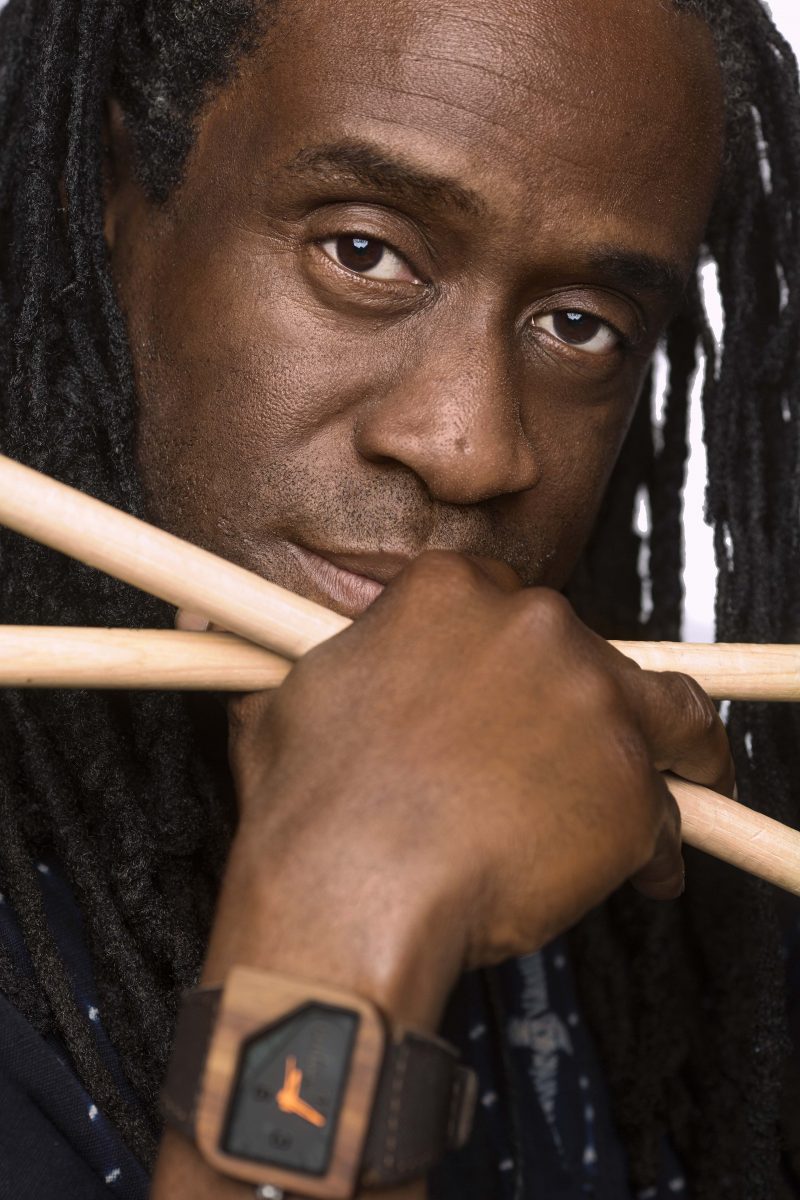
Will Calhoun laughs when I tell him how old I am. I was only three years old when his band Living Colour split back in 1995. I explain to him that because of this, Living Colour isn’t a known name within my peer group. However many of my friends do recognise their hit song “Cult of Personality” because of its inclusion in the video game Grand Theft Auto: San Andreas. He’s delighted by this.
“It feels great,” he tells me, “I have to say that I’m quite thrilled that it has transcended the rock and roll arena and has branched off into other arenas. It’s nice that the song transcended the music industry – which has come into an interesting phase – and is getting into the gaming industry and into television shows.”
Living Colour formed in New York in 1984, offering a unique fusion of politically charged rock, funk, jazz and metal. The band rose to fame, touring with rock heavyweights like Rolling Stones and Guns n Roses. They parted ways in 1995 with three records under their belt, but thankfully in 2000 the band regrouped. They are visiting Australia and New Zealand on tour in May and have a new record, Shade due out later in the year.
Despite the amount of time passed since Living Colour were at the height of prominence, the themes of their music remain as current as ever. Calhoun shares how the band wrote their biggest hit, ‘Cult of Personality’.
“We wrote that song in 1988. The fact that people still love it [is great]. I think it still sounds relevant today.
“The four of us have very strong ideals about the world and we talk about them. ‘Cult of Personality’ was written while we were setting up for a rehearsal. The topic of discussion was: what makes people follow people? What makes people follow Hitler, or Ghandi, or Dr King? Or Medgar Evers or John F. Kennedy? What is it about what someone is saying, or their charisma – that personality – that makes people want to follow them? And that was the conversation. And we were wondering: is it the same thing? Is it the same thing that made people follow Ghandi that made people follow Hitler? What are those intrinsic values? What are those definitions? How do you, as a person, identify with that person’s dialogue?
“And that was how the song was written. Vernon played a riff. I played a beat. And next we knew we had a song. All while we were setting up for sound check.”
Living Colour’s most recent release is an EP that centres around a cover of Notorious BIG’s song ‘Who Shot Ya?’. This track, along with another cover of Robert Johnsons ‘Preachin’ Blues’, are due to appear on Shade. I ask if there is a process that Living Colour go through to select songs to cover. Calhoun stops to think.
“We just covered ‘We Are Afraid Of Americans’ by David Bowie and I’ve been a fan of that song for so many years and it just felt so great to play it. We just cover songs we like as a band. We choose songs based on relevance to us, but often it is just playing homage to the person. It’s about paying respect to a person who, in our opinion, has done a creative amount of great work.
“As for Biggie Smalls… Corey Glover, our singer, is a massive fan of Biggie. Most of his hit songs he can rap to by heart. But it’s the impact. When you think of Robert Johnson verses Biggie… I just love that Living Colour has this wide open variety of songs to choose from. There’s no formula. We just pick what we like and we fool around with it and change the arrangement while still paying respect to the artist.”
So we already know two songs – both covers – appearing on Shade. Calhoun says that the rest of the record is the same Living Colour we know and love, but updated for 2017. He also adds that he loves the social commentary on the album.
He corrects me when I ask if the issues that the Black community faced 20-30 years ago are still the same today. He’s not rude, but informative. Clearly he is passionate about the themes that his band explore.
“These songs go beyond the Black community. They deal with the Māori community – down there where you live. The Aboriginal community in Australia. The Native American communities and indigenous communities around the world. They’re not relegated to black and white issues. Some of our songs deal with gender, discrimination, chauvinism, bullying, and those kinds of things. We write songs based upon what we experience in life. That’s what’s most fun about being a member of Living Colour.”
Again he corrects me when I try to rephrase my question, asking if the songs are for people of minority and those facing oppression.
“I think people of colour are not minorities. I think that they are a majority of people on the planet if you look at it in academic senses. I don’t like people using the term minority but I read that and I hear that all the time. In fact if you were to do the numbers or any real census of all the people on the planet, the people of colour are by far the majority. That’s neither here nor there, but when you use a term like minority, what you’re doing is you’re homogenizing a concept of people. You’re diminishing their value and painting a kind of a picture. That’s something that we want to break down in Living Colour – this homogenizing of culture. Even for black music.”
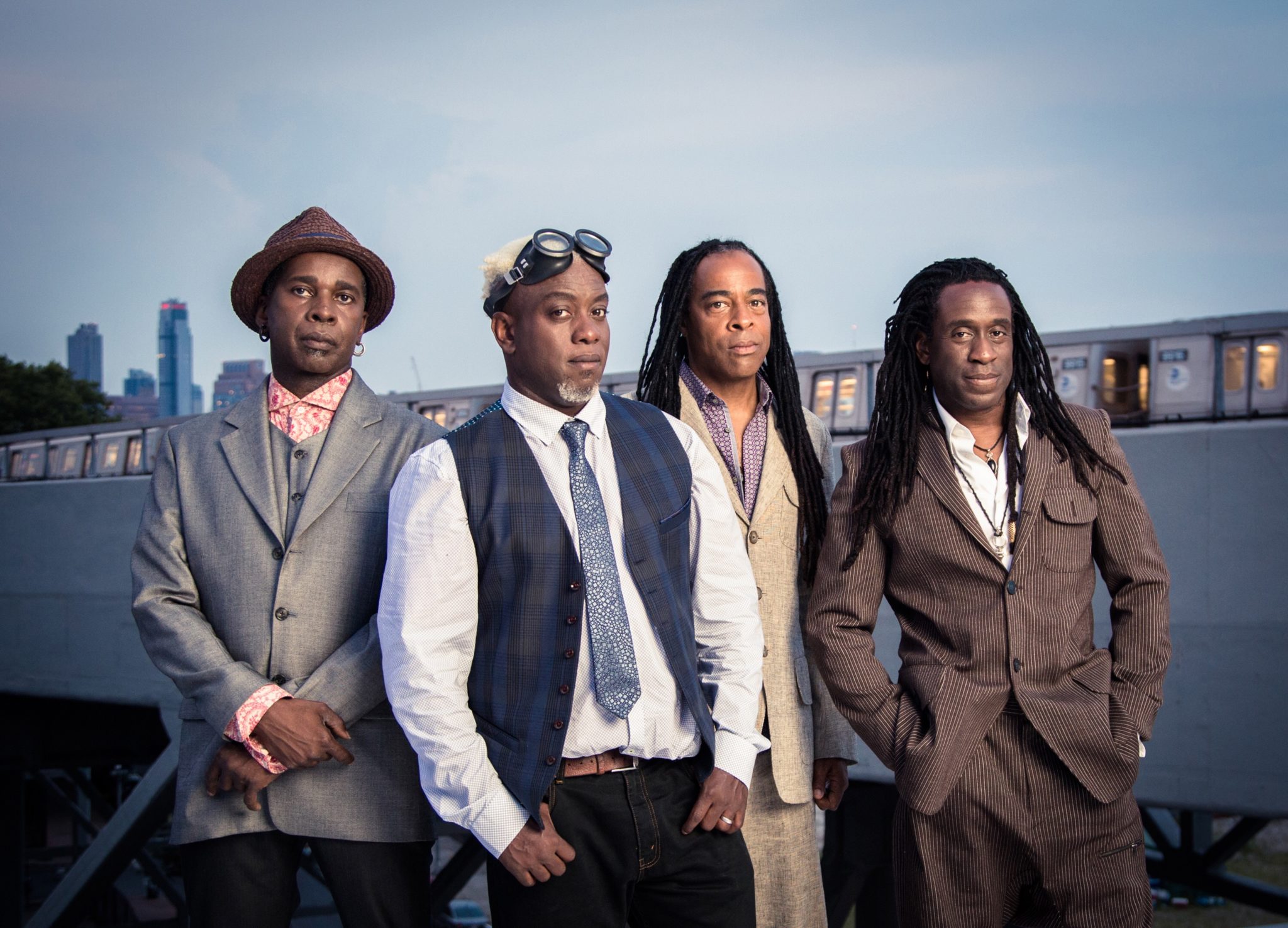
Image: Karsten Staiger
“When Living Colour first came on the scene in ’88 many people were surprised that we were black. And for us, we were shocked! Especially in our own country, to see that. Because black people invented rock and roll.
“The music’s for everyone – no doubt about it – but we are very careful with terminology and expressing ourselves in a way that’s all inclusive.
“We have a great song called ‘Wall’ that goes: ‘The wall between us all must fall.’ These walls that separate us by gender or by race, by skin colour, by financial interests. Ironically, that song was written mid-eighties. And here we are now in North America, with an administration that is discussing the possibility of building a wall.”
“Our music and lyrics are very present and relevant. And we hope that the music reaches people and might be . As an artist you always want to have present impact upon your audience.”
Calhoun is a nice guy. He comes across as friendly, and genuinely interested about me. I tell him that I’ve been up since before dawn for an ANZAC service, and that I play drums. When I mention that work as an early childhood teacher he showers me with encouragement.
Plus he’s patient. My calls kept cutting out annoyingly, but he remained accommodating the entire time. He tell’s me that this is the most interesting interview he’s ever had. This is possibly because I tried to come up with great questions, but it’s more likely because I keep having phone troubles.
As a drummer myself, I love Calhoun’s style. I’ve spent a lot of time watching Youtube videos with him playing, and explaining his approaches to drumming and the equipment he uses in his set up.
His interest in using electronics with drums started at a young age. Growing up in the Bronx, with his older brother’s generation responsible for pioneering hip-hop, meant that drum machines were commonly accessible. Seeing friends using the drum machines to programme beats and later hearing those beats on the radio prompted Calhoun’s desire to experiment with them himself.
“I didn’t want the drums to sound like drums,” he explains, “so I thought I could plug the drum machines into effect pedals and rack modules and delays and reverbs. And I thought about how I could manipulate that drum sound to get out of that idiom of being a drum? What would a drum sound like if it fed back? If it was looped? If it was sampled, or re-sampled?
“The same way a guitar player thinks about his or her guitar sound. Jimi Hendrix had a huge influence on me as an artist. Jimi was disconnected in a lot of ways. He was like an alien being. He took sounds and fed them into the guitar in ways that, as far as we were concerned, no-one had come up with before. And that’s the process I wanted to have with drums. So the influence came from both the increase in technology, and knowledge, experience and exposure with drum machines in my childhood and it just transcended.
“The experimentation with the technology forces you to create and change your sound. And that’s why I got into smaller drums. With my Nomad snare I wanted a bright sound, with a smaller drum for a smaller frequency response. I went to Sabian because I wanted cymbals that could work with electronic and acoustic music.”
This interest in combining electronic and acoustic sounds stepped up when he enrolled to study at Berkley, where he was a recording and engineering major. He had to choose a principle instrument – drums – but he chose to focus more on the stuff he didn’t know: learning about how microphones work and how to build consoles and create sound.
“I was a freak about sound. I wanted to know how Led Zepplin records sounded so amazing. What were they doing with the drum sound, the reverbs? The Old Columbia recordings… Why do James Browns recordings sound so great – so clean – today? We know they were great musicians, but how is it that they were able to make those great recordings with little 8-track recording studios?”
Later on in life he traveled around the world, living in places like Mali and Senegal where he learnt more about traditional drumming. Berkley was great as an institutional setting, but studying in various African nations gave Calhoun insight into thousands of years of teaching. Like his drum set uses electronic and acoustic elements, his style draws from both scientific and spiritual approaches.
It was fascinating hearing about the concept of ancestral beats. I asked him if he includes said beats in his playing, which launched him into an engrossing explanation. At first it sounded like something I’d dismiss, but Calhoun explained it in a way that made it sound plausible.
“I absolutely include them at all times. More so live because when playing drum solos I can introduce them to the audience in their traditional form. But at all times I include those beats. Sometimes it’s just pieces of the beats – a hit hat pattern, or a snare pattern or a kick pattern – but I’ll play them in their entirety in a drum solo because I can control what the beat means. Those beats have meanings and definitions. Those beats are like sentences. It has a subject, it has a verb… this kind of thing. So the beats are like a language, in a way.
“Those beats are part of rock and funk and James Brown style drumming. They are already borrowed bits and pieces. That’s the nature of music, with things able to be borrowed and transferred. I use them as much as possible, but they’ve been used by many great drummers before my time. If you listen to James Brown, a lot of the grooves on his records are Nigerian festive beats. And that’s why, in my opinion, James Brown’s music is loved by everyone – because historically it’s a celebratory rhythm being played.”
He explained how the body reacts to vibrations and tone. Certain sounds will make you feel happy, or relaxed, or upset. Think of fingernails on a chalkboard. Now think of waves lapping up on the shore at a beach. Our bodies have innate reactions to certain frequencies, so by extension it makes sense that specific alncestral drum beats can have particular effects on us.
He even takes the vibration concept another step, using a machine.attached to the drum throne he sits atop. The machine, called a BC2, sends vibrations up Calhoun’s body as an alternative to having a monitor. Calhoun dislikes monitors, comparing the act of a speaker blasting your own music back at you to riding a Harley Davidson and having the exhaust pumped back into your helmet.
Some Living Colour tracks are almost 30 years old. I ask Calhoun if he plays the songs differently now that has access to new equipment and technology. His answer revolves around a brilliant analogy of a hamburger.
There are formulas to the songs that he likes to keep, but he has changed as a parson over his career, living in different countries and using different technologies.
“A hamburger is a hamburger. You can put ketchup on it, or mustard or relish. You can make it well done, you can make it medium rare. But it’s still a hamburger. I look at my songs with Living Colour – my previous beats as a hamburger. I don’t want to eat it the way I used to eat it twenty years ago. I want to change it up and add different feels. A pocket or a groove or a feel is just a beat. But what are you adding to it? What spice or twist are you adding to it? Not pissing off the listener, but making it feel like it’s 2017.”
To conclude our chat I ask Calhoun one last question to make him laugh: does the British spelling of the name Living Colour ever lead to confusion? I can picture his grin down the end of the phone line as he answers. The band founder Vernon Reid is English, so made a deliberate choice to spell “colour” with the “U” included. But most Americans spell it incorrectly out of habit. It’s not much of an issue.
Before we finish Calhoun tells me how he’s looking forward to returning to New Zealand and getting another taste of our unique scenery, food and culture. I’m just as excited to see Living Colour play live for the first time.

Living Colour are playing the Powerstation in Auckland on Thursday 11 May.
Tickets from AAA Touring
Will Calhoun links:
Website: http://www.willcalhoun.com/
Facebook: https://www.facebook.com/willcalhounmusic/
Twitter: https://twitter.com/WillCalhounDrum
Living Colour links:
Website: http://www.livingcolour.com/
Facebook: https://www.facebook.com/LivingColour/
Twitter: https://twitter.com/LivingColour
Youtube: https://www.youtube.com/channel/UCBp5wftf7WswgIko42GUfWQ
Joseph James